

SEPTEMBER – OCTOBER 2022
See full newsletter
Enabling different voices during the production of ETESA reports breaks researcher bias, improves the quality of recommendations and facilitates the decision-making process.
 The Health Technology Assessment or HTA is a multidisciplinary process that uses explicit methodologies to determine the value of a health technology, which guides and bases decision-making so that health systems and organizations allocate resources efficiently. For example, whether coverage of a certain new drug or diagnostic device is appropriate in defined patient groups.
Traditionally, for the preparation of ETESA reports, teams of experts (including health professionals, epidemiologists, librarians and economists) have been in charge of reviewing, analyzing and synthesizing the evidence that helps to objectively answer the different questions or queries, just as we have done in the IECS for 18 years. However, en úIn recent years, the conviction has grown that, given that the incorporation of health technologies affects different actors in the health system, it is also important to implement mechanisms that guarantee their effective participation in all phases of the development process, from the design of its structure and governance to final recommendations.
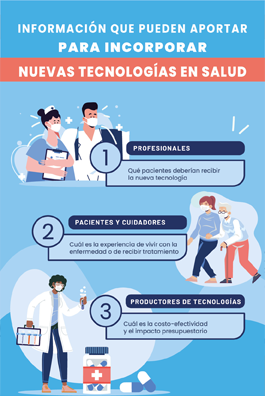
It is what we informally baptize as “public consultation”, but which is strictly speaking better defined as a deliberative process that involves different relevant actors: scientific societies, patient associations, technology producers, doctors and patients, health and technology financiers. general population. Encouraging their participation and enabling the space to listen to different voices during the production of ETESA reports is essential to improve the quality of the recommendations and facilitate the decision-making process, because it allows dimensions to be incorporated into the document that go beyond the cold analysis of the published literature, including priorities, desires, categories or values of the different actors. Probing what is important to them from the beginning, instead of simply asking for their opinion at the end, breaks down the researcher's bias and often reorients the questions that should be answered in the report.
So, for example, when analyzing a new drug for ovarian cancer, perhaps the technical team would focus primarily on the effect on mortality, quality of life, and relapse rates. But, for patients, it may be equally or more important to know whether the treatment infusion in the hospital will take away from their time at home or at work; for doctors, whether the drug is effective in a certain subgroup that currently has few treatment options; and for producers, if the cost analysis will take into account indirect savings due to fewer hospitalization expenses or the positive impact on labor productivity.
The deliberative process is a challenge and a necessity for health systems themselves, a path that we have only just begun to travel. Currently, half of our ETESA reports include the participation of some of these actors, and we would like to see more. For example, the lack of formal mechanisms to involve actors in many countries can lead to the perspective of interest groups with greater power of influence excluding other voices, such as that of patients. Ultimately, decisions are going to be made the same. Participating in the process not only enables the possibility of influencing specific recommendations, but also allows us to better understand and accept the prioritization decisions and the bases that support them.
View here videos about the deliberative process.
At Dr. Andrea Alcaraz, Health Technology Assessment Coordinator.