

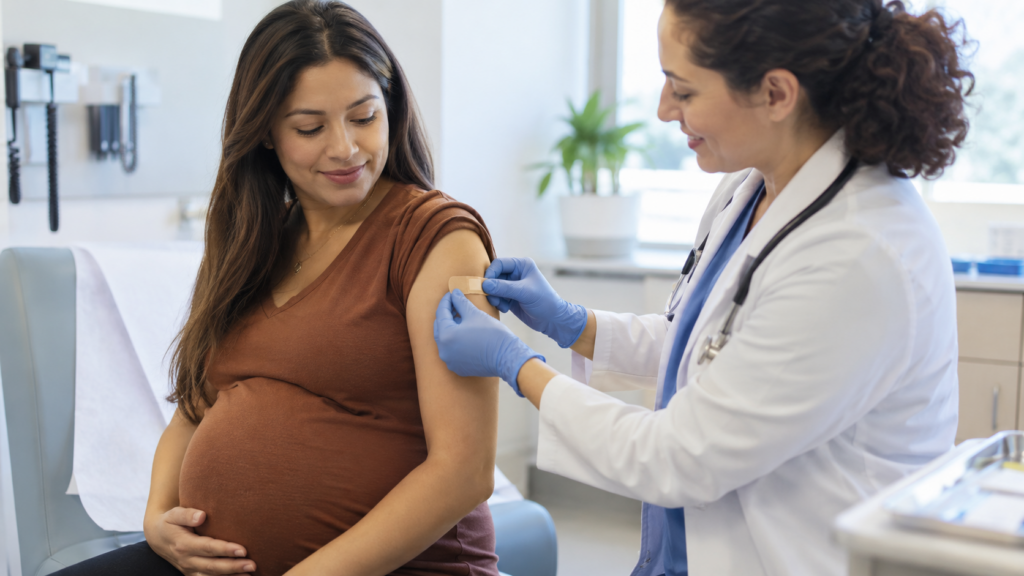
A live systematic review coordinated by the IECS compiled 316 studies and 1.887.042 vaccinated pregnant women on the safety of COVID-19 vaccines during pregnancy. Its results were presented to the WHO in February 2026, forming one of the sources of evidence for the organization's first position paper on these vaccines.
The recent publication by the World Health Organization (WHO) of its first position paper The report on COVID-19 vaccines reaffirms that the evidence shows no "warning signs" regarding immunization in pregnant women, and therefore recommends administering one dose of the vaccine in each pregnancy, at any gestational stage, preferably during the second trimester. This recommendation stems in part from data from a live systematic review and real-time monitoring of more than 300 studies involving nearly 2 million vaccinated pregnant women, coordinated by the Institute for Clinical and Health Effectiveness (IECS) since 2020 and presented to the organization in February 2026.
“Pregnant people are one of the groups for whom the available evidence is both scarcer and most needed. However, it was essential to have evidence to determine that the benefits outweigh the potential risks,” she noted. Dr. Mabel Berrueta, director of the Department of Maternal and Child Health Research at IECS and principal investigator of the project Safe in Pregnancy, Safe in Children, an international initiative for the synthesis of living evidence that gathers and keeps updated the evidence on the safety, efficacy, effectiveness and immune response of COVID-19 vaccines during pregnancy since 2020.
“The complexity of Safe in Pregnancy, Safe in Children It's twofold. On the one hand, we work with populations for whom vaccine evidence is scarce and fragmented, because pregnant women and children are often excluded from clinical trials. On the other hand, the dynamic systematic review format forces us to operate at a different pace than traditional research: the search, selection, analysis, and interpretation never end; they are repeated,” he added.
The evidence submitted to the WHO included 316 studies, available up to December 1, 2025. Of these, 64 were conducted primarily during the period of Omicron variant circulation, beginning in January 2022. In total, the studies included 1.887.042 vaccinated individuals. To compare outcomes between vaccinated and unvaccinated pregnant women, only studies with results adjusted for other variables were meta-analyzed to minimize the risk of bias.
The priority outcomes defined by the WHO were spontaneous abortion and stillbirth to assess the safety of pregnant people, and preterm birth and admission to the neonatal intensive care unit to assess the safety of newborns. Other potential complications during pregnancy and childbirth, such as hypertensive disorders, postpartum hemorrhage, or premature rupture of membranes, as well as neonatal death and congenital malformations, were also analyzed among the adverse outcomes in newborns.
Overall, “no signs of maternal or newborn safety issues were identified in vaccinated mothers for priority outcomes, although the certainty of the evidence was limited mainly due to the observational design of the studies and the imprecision of the results,” the lead co-investigator noted. Dr. Agustín Ciapponi, director of the Cochrane Center Argentina of the IECS and co-investigator of the Safe in Pregnancy, Safe in Children project.
The WHO document concludes that the available evidence does not show an increased risk of complications for pregnant women or newborns associated with vaccination during pregnancy. It also points out some areas that require further research, such as the severity of COVID-19 during pregnancy and in infants under 6 months of age. It also emphasizes the importance of receiving the vaccine during each pregnancy.
The project Safe in Pregnancy, Safe in Children Today, the monitoring cycle for effectiveness and safety in pregnancy also includes other vaccines: those for respiratory syncytial virus (RSV), chikungunya, Lassa fever, mpox, and Ebola—all with registered protocols, meta-analyses, risk of bias assessments, and certainty of evidence according to the GRADE scale. All the updated information is integrated into interactive dashboards that healthcare professionals can consult in a matter of minutes. “The real challenge is translating that volume of methodological work into meaningful terms for those who have to make decisions. The complexity lies not in doing it once, but in consistently doing it,” stated Dr. Berrueta.
Some findings of the investigation
Safety during pregnancy
- Spontaneous abortion: Of the 53 studies that analyzed this outcome, 5 allowed for an adjusted comparison between vaccinated and unvaccinated pregnant individuals, with a total of 29.853 vaccinated pregnant individuals. The results showed 15 fewer spontaneous abortions per 1.000 pregnancies among vaccinated individuals, although the estimate was imprecise and the certainty of the evidence was very low.
- Fetal death: Of the 58 studies that analyzed this outcome, 10 provided adjusted data for comparison, with 261.857 vaccinated pregnant individuals. In 9 studies conducted before 2022, fetal death was infrequent. Two fewer fetal deaths per 1.000 pregnancies were observed among vaccinated individuals. However, the certainty of the evidence was very low, mainly due to study limitations and the small number of events.
Safety in newborns
- Admission to a neonatal intensive care unit: Of the 17 studies that analyzed this outcome, 10 provided adjusted data, with 82.983 vaccinated pregnant women. Before January 2022, there were 6 fewer admissions to neonatal intensive care units per 1.000 live births among children of vaccinated individuals. The certainty of the evidence was low, mainly due to study limitations.
- Premature birth: In 14 studies conducted before January 2022, 3 fewer premature births per 1.000 births were observed among vaccinated individuals. The certainty of the evidence was very low due to limitations in the studies, as the results were not entirely consistent across them. In studies conducted after January 2022, the available results were somewhat more limited and showed 13 fewer premature births per 1.000, also with very low certainty.
- Extreme preterm birth (less than 28 weeks): Of the 17 studies that analyzed births before 32 weeks, 4 provided adjusted data, with 98.293 vaccinated pregnant individuals. Before January 2022, there were 2 fewer extremely preterm births per 1.000 births among vaccinated individuals. In this case, the certainty of the evidence was low. No estimates were available for the period after January 2022.